
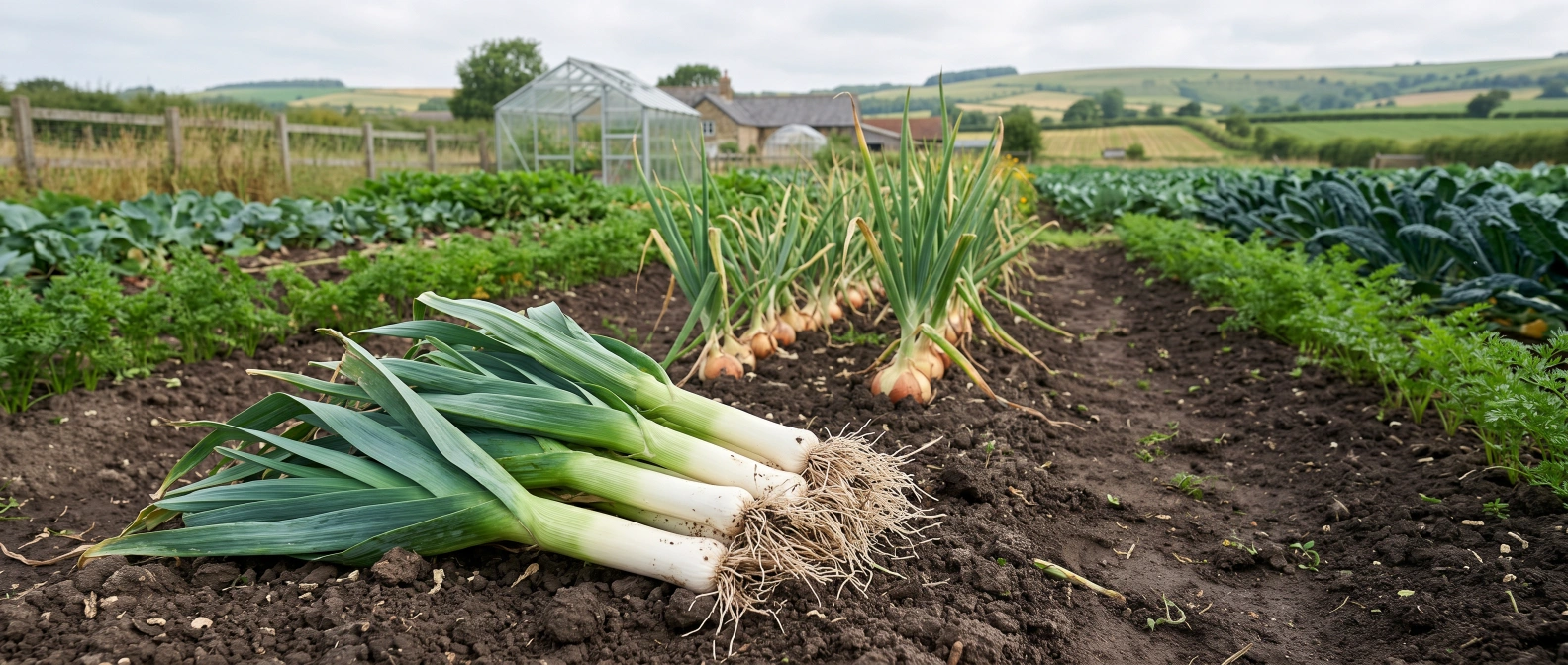
Leek looks like a close relative of onion but genuinely isn't -- it's a different species entirely, doesn't cross-pollinate with onion, shallot or spring onion, and behaves completely differently in the ground too. Where onion is dried and stored, leek is a living larder: dig it as needed right through winter, and mature plants shrug off frost and snow that would finish off most other crops on this site.
Water need
Shallow-rooted and doesn't tolerate drying out well -- even watering through summer keeps growth steady.
Calories at a glance
610 kcal/kg -- ahead of onion, carrot and most root vegetables on this site's own scale (scale is log-based across all 55 crops in the calculator).
Temperature Range by Month
Month on the bottom, temperature up the side. The pale green background is what the plant can survive at all -- fatal above or below it, labelled directly on the chart where that applies to your zone. The coral band is its ideal range, and only fades in during the months this zone would actually have the crop in the ground -- reusing the exact same sowing/harvesting data as the calendar further down the page. The blue line is real monthly climate data (not a modelled estimate) for a representative rural/agricultural location in this zone -- a small farming town or agricultural research station rather than a major city, to avoid the warmer bias city weather stations have. For the actual verdict on how well this crop does in your zone, see the badge at the top of the page -- that's based on the site's own researched yield figures, not this chart.
Quick Start: Sowing to Harvest
- Start under cover. Sow seed under cover in late winter or early spring -- leek needs a long season, so an early start under glass or a cold frame matters.
- Transplant into holes, not a flat trench. Once seedlings are pencil-thick, drop them into deep dibbed holes rather than planting on the flat -- this is what gives leek its long, blanched white shank, and simply watering in (not backfilling) lets soil settle naturally around the stem.
- Keep the soil consistently moist. Leek is shallow-rooted and doesn't tolerate drying out well through summer -- even watering keeps growth steady.
- Earth up if you want an even longer white shank. Mounding soil around the base as the plant grows extends the blanched portion further, though this is optional refinement rather than essential.
- Leave it in the ground and harvest as needed. Dig leeks as you need them right through winter rather than lifting the whole bed at once -- the site's own crop data treats this as a living larder, and mature plants are genuinely frost-hardy.
Sowing & Harvesting Calendar
Pick your zone under "Temperature Range by Month" above and this updates too. The Sow row shows the under-cover start window for this crop's long season. The Harvest row has two shades: solid green is the main harvest window, while the striped tail reflects the living-larder option covered in Storage & Preservation below -- dig as needed rather than lifting the whole bed at once. Notice Arid shows no window at all -- this site's own yield data marks leek as not viable there.
Calories & Yield
Leek is a reasonable calorie crop at about 610 kcal per kg -- ahead of onion, carrot and most root vegetables on this site's own scale. Subtropical, Mediterranean and Maritime zones give the best yields here.
| Climate Zone | Yield per plant | Calories per plant | Viability |
|---|---|---|---|
| Tropical / Humid | 0.3 kg | 183 kcal | Viable |
| Subtropical | 0.4 kg | 244 kcal | Viable -- best yield |
| Mediterranean | 0.4 kg | 244 kcal | Viable -- best yield |
| Temperate Maritime | 0.4 kg | 244 kcal | Viable -- best yield |
| Temperate Continental | 0.35 kg | 213.5 kcal | Viable |
| Cool / Boreal | 0.25 kg | 152.5 kcal | Viable |
| Arid / Semi-Arid | -- | -- | Not viable |
| Highland / Alpine | 0.25 kg | 152.5 kcal | Viable |
Figures per plant sown, from the site's own crop database.
Varieties Worth Knowing
Leek varieties mainly differ in earliness and cold-hardiness -- some are bred as a summer/autumn crop, others specifically to stand through a hard winter. All the varieties below are open-pollinated (OP), meaning seed saved from them breeds true and is worth keeping under this site's seed-saving approach; none are F1 hybrids.
Seed Saving -- Quick Guide
Leek crosses with elephant garlic -- both Allium ampeloprasum -- but not with onion, shallot or true garlic, all different species. It's biennial, needing a full second year before it flowers.
SERVINGS, NOT DAILY CALORIES This works out plate-sized servings of leek from your seed during its fresh harvest window only, not your group's full daily calorie needs. For that, use the main calculator.
BIENNIAL Leek is a biennial, not an annual -- it doesn't produce seed in its first year. Plants grow through year one, a few overwintered plants flower and set seed in year two, and that seed is only ready to sow in year three. If you're starting from scratch with no ongoing seed supply, that means having enough seed on hand for both year one's and year two's sowing up front. Plan for roughly double the seed quantity below if that's your situation.
Estimated for your selected zone above, using this site's own germination, loss and yield figures for leek -- a helping is roughly what you'd put on a plate as part of a meal with other veg. Treat it as a planning estimate, not a promise.
Storage & Preservation
The site's own crop data models leek as a living larder, harvested from October through March -- one of the most reliable overwinter crops for maritime zones specifically, according to the crop database's own notes.
Dig only what's needed at a time and leave the rest standing -- mature leeks tolerate genuinely hard freezes and even a blanket of snow, and a light frost is said to improve their flavour rather than harm them.
Growing Leeks Without Bought Inputs
Leek shares leek rust and onion white rot risk with this site's other alliums -- rust shows as orange pustules on the leaves and is worsened by overcrowding and poor airflow, while white rot is a soil-borne fungus that persists for years once established.
Good spacing and airflow is the main input-free defence against rust -- avoid overcrowding plants, especially in humid conditions.
Crop rotation is essential against white rot -- once established in a bed it persists for many years, so never repeat leek, onion, shallot or spring onion in the same spot back to back.
Frequently Asked Questions
Does leek cross-pollinate with onion, shallot or spring onion?
No -- despite the family resemblance, leek (Allium ampeloprasum) is a genuinely different species from onion, shallot and this site's spring onion, which are all Allium cepa. Different species don't cross under normal garden conditions.
What does leek actually need isolating from, then?
Other leek varieties, and elephant garlic -- which is also Allium ampeloprasum, just a different cultivated group of the same species. If you're growing both leek and elephant garlic for seed, treat them as real cross-partners.
Can I leave leek in the ground over winter instead of storing it?
Yes -- the site's own crop data models leek exactly this way, as a living larder harvested from October through March. It's one of the most reliable overwinter crops for maritime zones specifically, and a light frost is said to improve its flavour.
How cold and hot can leek survive?
Roughly -15°C to 29°C once mature, with young seedlings noticeably more frost-tender than established plants. Mature leeks are genuinely tough -- a blanket of snow doesn't harm them, and cold snaps are said to improve flavour rather than damage the crop.
Why isn't leek viable in Arid zones on this site?
Leek needs sustained, fairly cool, evenly moist conditions over a long season to bulk up its shank properly -- genuine aridity works against both of those at once, which is why the site's own yield data marks it not viable there.
Is leek a good calorie crop for self-sufficiency?
Reasonable -- around 610 kcal per kg, ahead of onion, carrot and most root vegetables on this site's own scale. Combined with its long living-larder harvest window, it's one of the more genuinely useful winter staples here.